
How Mierzwa Won the Scoring Title With 71 Goals
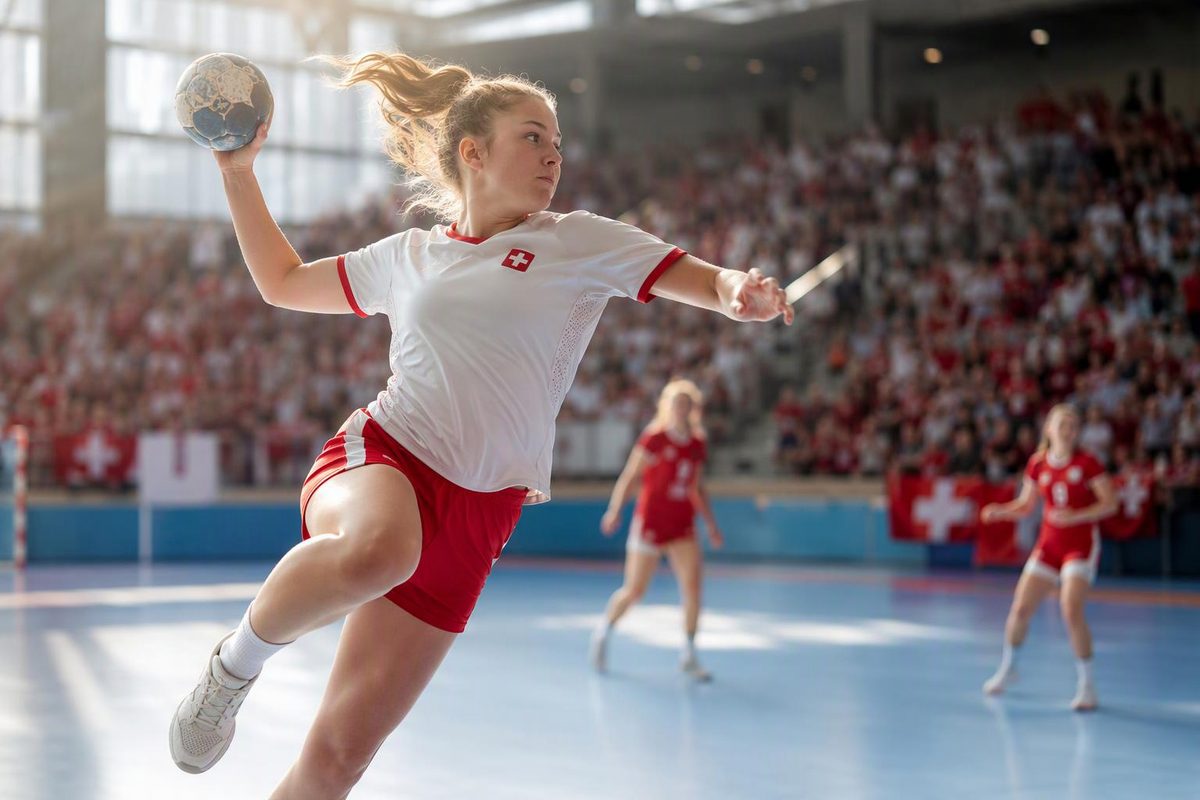
Break down Lauryn Mierzwa’s 2026 U18 world scoring title: eight matches, 90 shots, 27 penalties and an 11-goal finish as Switzerland took fifth place.
Lauryn Mierzwa scored 71 goals in eight matches for Switzerland at the 2026 IHF Women’s Youth World Championship in Romania, winning the tournament’s top-scorer award. She was also selected as the All-Star left wing. The 71 is a tournament total—not a single-match score or a season tally—and refers specifically to the women’s under-18 international competition. IHF All-Star announcement, 9 August 2026
Her scoring line combines volume and efficiency: 71 goals from 90 attempts, an average of 8.88 goals per match and an overall shooting conversion of 78.9%. Switzerland finished fifth, with Mierzwa contributing 11 goals in its final victory over Slovakia. The individual scoring title and the team’s placing are separate results: Switzerland did not need to reach the medal matches for her to finish as the competition’s leading scorer.
Choose total goals or goals per match; compare Mierzwa with the other two leading scorers.
Compare the Leading Three Scorers
Lauryn Mierzwa leads: 71 goalsShe won the tournament’s top-scorer award. All three players are ranked below by total goals.
| Player | Goals | Matches | Goals/ Match |
|---|---|---|---|
| Lauryn MierzwaSwitzerland | 71 | 8 | 8.88 |
| Shuoyan ZhangChina | 69 | 8 | 8.63 |
| Hina MiuraJapan | 63 | 7 | 9.00 |
Goals per match are calculated from totals and appearances, not minutes played. The comparison covers these three players only.
Shot Totals and Mierzwa’s Penalty Split
Mierzwa: 71/90 shots; Zhang: 69/102; Miura: 63/94.
Mierzwa converted 27/32 seven-metre throws (~84.4%). Those goals are included in her 71 and account for ~38% of the total. Subtraction leaves 44/58 non-penalty attempts (~75.9% conversion).
Mierzwa’s overall conversion is 78.9%, rounded to 79% by the IHF. Her All-Star left-wing selection does not mean every goal was a wing shot.
Source: IHF final top-scorer statistics, checked 4 October 2026. Rates calculated from the listed totals.
Mierzwa Led on Total Goals, Not Goals Per Match
Mierzwa’s 71 goals put her ahead of China’s Shuoyan Zhang, who scored 69, and Japan’s Hina Miura, who scored 63. Mierzwa and Zhang each played eight matches; Miura played seven. Those appearances matter when interpreting the standings, because the tournament award recognises accumulated goals rather than goals divided by matches played.
| Player | Goals | Matches | Goals/Match |
|---|---|---|---|
| Lauryn Mierzwa, Switzerland | 71 | 8 | 8.88 |
| Shuoyan Zhang, China | 69 | 8 | 8.63 |
| Hina Miura, Japan | 63 | 7 | 9.00 |
Source: IHF final top-scorer statistics, checked 4 October 2026. Goals-per-match figures are calculated from the listed totals and appearances.
Mierzwa averaged 8.88 goals per match, calculated as 71 divided by eight. That is an average across her tournament appearances, not a claim that she scored the same number in each match. The final-game total alone shows why an average should not be read as an individual match score.
Miura’s 9.00 goals per match was the highest rate among these three players. She nevertheless finished behind Mierzwa on total goals because she played one fewer match. Both statements can be true: Mierzwa was the tournament’s scoring champion, while Miura had the higher per-match average within this comparison.
The distinction changes the answer to a statistical comparison. For the official top-scorer result, use the goals column. For scoring output per appearance, use goals per match. Neither measure supplies minutes played, so neither establishes who scored most frequently while actually on court. The supplied figures do not include a minutes-based scoring rate.
It would also be misleading to project Miura’s average into an additional match and treat that hypothetical total as an alternative tournament result. Her recorded total is 63 from seven appearances. Mierzwa’s recorded total is 71 from eight. The standings describe the matches each player actually played, not an equal-schedule simulation.
Her 71 Goals Came From 90 Attempts
The IHF statistics list Mierzwa with 71 goals from 90 shots. Dividing goals by attempts gives a calculated overall conversion of 78.9%, which the IHF page rounds to 79%. The percentage uses all her recorded attempts, including seven-metre throws; it is not a wing-only shooting figure.
The other leading scorers’ shooting lines provide useful context without changing the award result. Zhang recorded 69 goals from 102 shots, while Miura recorded 63 from 94. Mierzwa finished two goals ahead of Zhang while taking 12 fewer shots. She also recorded more goals than Miura from fewer total attempts.
| Player | Goals/Shots |
|---|---|
| Lauryn Mierzwa | 71/90 |
| Shuoyan Zhang | 69/102 |
| Hina Miura | 63/94 |
These are tournament-wide shooting lines, not like-for-like collections of chances. Players can have different mixes of penalties, wing attempts, fast breaks and other finishes. Mierzwa’s figures establish that she converted a high proportion of her recorded shots; they do not establish that every player faced the same shooting opportunities.
The comparison with Zhang is particularly clear because both played eight matches. Mierzwa’s higher goal total was not a consequence of an extra appearance in that pairing. She scored more while recording fewer attempts. That supports an efficiency comparison at the aggregate level, although it does not explain the difficulty of each shot or the defensive circumstances behind it.
An attempt is also a different unit from a possession. The supplied scoring statistics do not give Switzerland’s possessions, Mierzwa’s touches or the number of attacks in which she participated. Her 78.9% therefore answers how often her recorded attempts became goals—not what share of all Swiss attacks she finished successfully.
Penalties Supplied 27 of Her 71 Goals
Mierzwa converted 27 of 32 seven-metre throws, handball’s penalty shots. Those 27 goals are already included in her tournament total. Adding them to 71 would count the same goals twice.
Penalties accounted for approximately 38% of her goals. Her seven-metre conversion was approximately 84.4%, calculated from 27 goals divided by 32 attempts. The remaining scoring line can be obtained by subtracting the penalty goals and attempts from her overall totals.
| Shot Group | Goals | Attempts | Conversion |
|---|---|---|---|
| All Attempts | 71 | 90 | 78.9% |
| Seven-Metre Throws | 27 | 32 | 84.4% |
| Non-Penalty Attempts | 44 | 58 | 75.9% |
Calculations use the IHF goals, shots and seven-metre totals cited above. Percentages are rounded.
Subtracting 27 penalty goals from 71 leaves 44 non-penalty goals. Subtracting 32 penalty attempts from 90 leaves 58 non-penalty attempts. Her non-penalty conversion was therefore approximately 75.9%. This is a derived aggregate, not a separate claim that every remaining attempt came from the same location.
The split shows why the overall percentage needs its denominator explained. Her penalty conversion was higher than her non-penalty conversion, and both groups contribute to the combined figure. Using 71 goals against only her non-penalty attempts would mix incompatible categories and produce a meaningless shooting percentage.
Penalty responsibility also affects how a scorer accumulates goals. Mierzwa’s total reflects both her finishing and the opportunities she took from seven metres. Removing those goals can help isolate non-penalty production, but it does not revise the official scoring title: converted penalties count toward the tournament standings.
Conversely, describing the entire performance as penalty-driven would omit her 44 non-penalty goals. The useful reading is the full split. Seven-metre throws made a substantial contribution, while her remaining attempts still produced more goals than her penalties did. Both parts belong in an account of how she reached 71.
All-Star Left Wing Does Not Mean 71 Wing Goals
Mierzwa’s All-Star selection identifies her honoured position, not the shot category of every goal she scored. The IHF final statistical report records 28 of her goals in the wing category and 11 from fast breaks, alongside her penalties and other finishes.
Those figures should remain attached to the report’s categories. A fast-break goal can be scored by a player whose position is left wing, but that does not make it a wing-category goal in the statistical breakdown. Likewise, a seven-metre goal remains a penalty goal regardless of the shooter’s usual position.
The 44-goal non-penalty figure is broader than the 28-goal wing figure. It includes her recorded non-penalty finishes across categories, rather than only attempts classified as wing shots. Calling the non-penalty conversion her “wing shooting percentage” would therefore mislabel the calculation.
The supplied draft does not give her wing-attempt total, so a wing-only conversion percentage cannot be established here. It gives wing goals, overall attempts and penalty attempts, but those are not interchangeable denominators. The overall 78.9% and non-penalty 75.9% remain valid for their stated groups; neither should be relabelled as positional efficiency.
Eleven Goals Against Slovakia Completed the Total
Mierzwa entered Switzerland’s last match with 60 goals and added 11 in the 37:31 victory over Slovakia on 9 August. That brought her tournament total to 71. She was named Player of the Match in the fifth-place playoff. IHF placement-match report
Her 11 goals represented 29.7% of Switzerland’s scoring in that match. This percentage uses the team’s 37 goals as its denominator, rather than Mierzwa’s attempts or her tournament total. It measures her share of Swiss goals on the day; it is not a shooting-conversion statistic.
Switzerland led 17:15 at half-time, then scored 20 goals after the break while Slovakia scored 16. Those team figures explain the final 37:31 score, but the supplied data do not split Mierzwa’s 11 goals between the two halves. Her individual contribution should not be assigned to a particular period without that breakdown.
The last match is central to explaining the headline number because it connects her pre-match tally of 60 with the final tally of 71. It also illustrates the difference between tournament and match statistics: 71 describes eight appearances; 11 describes the Slovakia game; 29.7% describes her share of Switzerland’s goals in that game.
The win secured Switzerland’s best finish in the competition, improving on its previous placements of 21st and 14th. Fifth place is the team result associated with Mierzwa’s scoring title, not evidence that Switzerland won the championship. Her final scoring contribution and the placement victory can be reported together without confusing individual and team honours.
Top Scorer, All-Star and MVP Were Separate Honours
Mierzwa earned two distinct tournament honours: top scorer and All-Star left wing. Spain’s Elene Fresco Bastarrika was named tournament MVP, according to the IHF awards announcement linked above. Mierzwa’s scoring lead should therefore not be described as an MVP award.
The strongest supported summary is specific: Mierzwa led the 2026 women’s U18 world tournament with 71 goals in eight matches, converted 71 of 90 attempts, and helped Switzerland finish fifth. Her 27 successful penalties are part of that total, while her 11-goal final appearance completed it.
The figure does not by itself establish an all-time youth-world scoring record. No historical record comparison is supplied here. It establishes the scoring leader of this edition, with a clear distinction between the official total, her per-match rate, her shot conversion and her positional recognition.