
History of handball: from 11-a-side fields to seven-a-side courts
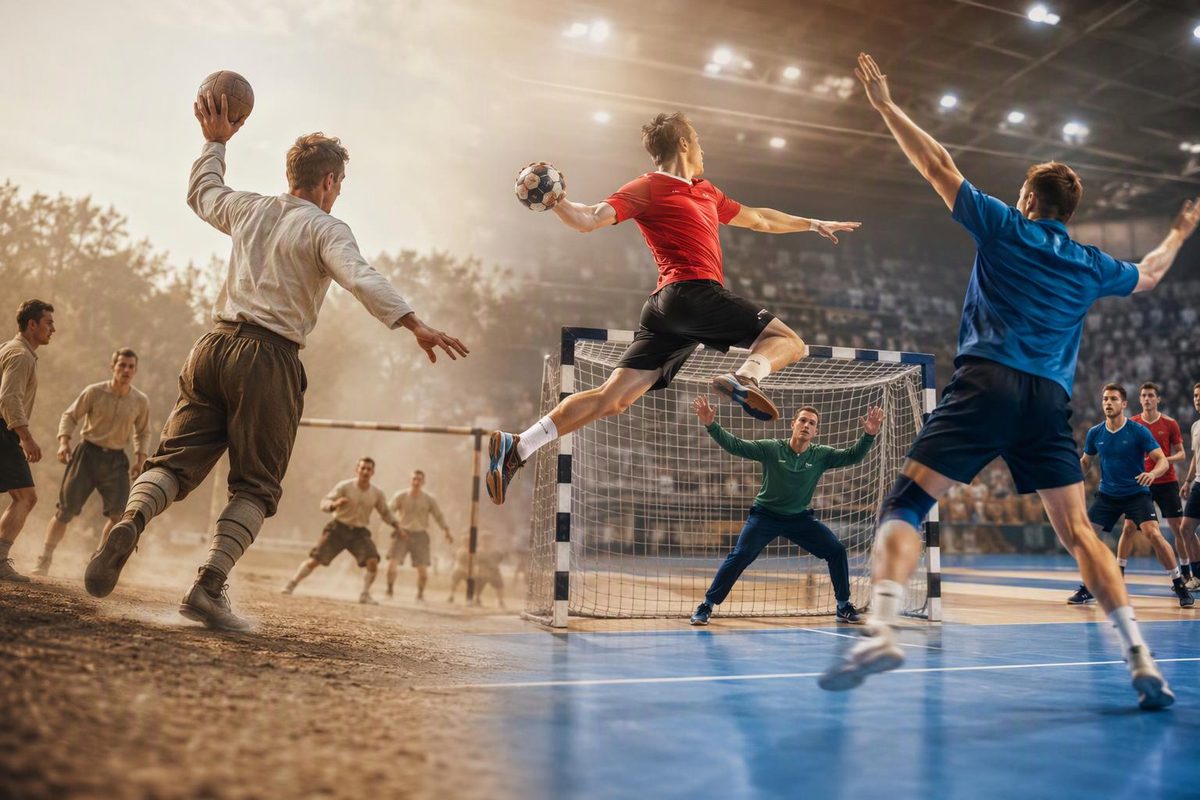
Trace handball’s origins, World Championship and Olympic milestones, and rule changes—and learn why historical scores need context.
Modern team handball developed in northern Europe in the late 19th and early 20th centuries. It did not emerge fully formed from one inventor: Danish rules, German rule development and competing forms of the game all contributed. Its biggest transformation was the shift in prominence from 11-a-side field handball to the seven-a-side game now associated with indoor courts. Olympics.com’s history describes both forms and their overlapping World Championship era.
That distinction matters when reading old results. A field-handball title and an indoor-handball title belong to different competitive records, even when the country and year are identical.
Origins: Denmark’s rules and Germany’s development
The IHF dates the first published handball rules to Denmark in 1906, followed by modern rules in Germany in 1917. Games resembling handball were already being played in both countries before those milestones. IHF historical overview
The German story explains why 29 October 1917 is often called handball’s birthday. On that date, Berlin gymnastics organiser Max Heiser established that the game he had developed for women, previously called Torball, should be named handball. His ideas were formalised in rules.
In 1919, Carl Schelenz developed Heiser’s game further, allowing physical contests and reducing the ball size. He adopted elements including field dimensions and team size from football. These were important steps in the development of field handball—not the creation of today’s indoor game in a single moment. German Handball Federation’s centenary history
The international timeline: field and indoor handball overlap
The move indoors was gradual. Field and seven-a-side handball had separate international competitions, and the first women’s championship classified as “indoor” was actually played outdoors. Here, indoor identifies the form of handball, not necessarily the venue.
The following milestones come from the IHF’s institutional timeline:
| Year | Milestone | What to distinguish in the records |
|---|---|---|
| 1928 | International Amateur Handball Federation founded in Amsterdam | The predecessor of the IHF |
| 1936 | Men’s field handball appears at the Berlin Olympics | The 11-a-side form, not modern indoor handball |
| 1938 | First men’s indoor World Championship, in Berlin | The starting point of the men’s indoor world-title series |
| 1946 | International Handball Federation founded in Copenhagen | The modern international governing body |
| 1954 | Second men’s indoor World Championship, in Sweden | The first men’s indoor Worlds organised by the IHF |
| 1957 | First women’s indoor World Championship, in Yugoslavia | Seven-a-side competition played at outdoor venues |
| 1969 | Field World Championship and European Cup do not take place because too few teams enter | The decline of international field handball |
| 1972 | Men’s indoor handball makes its Olympic debut in Munich | A new Olympic era after the 1936 field tournament |
| 1976 | Women’s indoor handball makes its Olympic debut in Montreal | The beginning of women’s Olympic handball |
A common source of confusion is 1938 versus 1954. The former was the first men’s indoor World Championship; the latter was the first organised by the newly established IHF. Neither date should be substituted for the other without explaining the scope.
For the later Olympic era, see our Olympic handball results by nation, which keeps men’s and women’s entries identifiable.
Club competitions and the European Championship era
International club handball developed alongside national-team tournaments. In 1956, the IHF approved a European competition between city teams; it subsequently became a competition between leading clubs and evolved into today’s men’s EHF Champions League. The women’s European Champions Cup was launched in 1961, becoming the predecessor of the women’s Champions League. IHF timeline
The European Handball Federation was founded in 1991, and the first men’s and women’s EHF European Championships followed in 1994. Portugal hosted the men’s tournament; Germany hosted the women’s.
Those inaugural finals produced 55 combined goals in the men’s match and 50 combined goals in the women’s match—not goals per team. Sweden beat Russia 34:21, while Denmark beat Germany 27:23. Men’s EHF EURO history; women’s EHF EURO history
Final totals of 50 or more goals therefore predate the recent rule changes discussed below. These two matches do not, by themselves, establish a scoring trend.
Modern rules—and how to compare historical scores
Under the IHF’s July 2025 rules, the familiar modern game uses a 40 × 20-metre court, with up to seven players per team on court and two 30-minute halves for players aged 16 and above. IHF Rules of the Game, rules 1:1, 2:1 and 4:1
Rules within that framework have continued to change. Two relevant milestones are:
- 2016: changes made it easier to replace the goalkeeper with a seventh outfield player, without that player having to wear a goalkeeper bib, and introduced a six-pass limit after the passive-play warning. EHF announcement; IHF explanation of the goalkeeper substitution change
- 2022: the baseline passive-play allowance fell from six passes to four, and a throw-off area four metres in diameter was introduced for top-level competitions. The IHF presented these changes as ways to make play more dynamic. IHF announcement
These are relevant markers when comparing eras, but a rule-change date alone does not prove how many extra goals it caused. More attacks and better shooting conversion are different explanations for a higher score.
For a historical comparison, keep the same form of handball, sex, age level and competition stage, and identify extra time. Comparing finals with finals is more meaningful than treating a final as representative of an entire tournament. Our World Championship final-goals series provides that narrower view, with men’s and women’s results kept separate.