
Why Handball Counts Attacking Intent and Passes, Not Possession Seconds
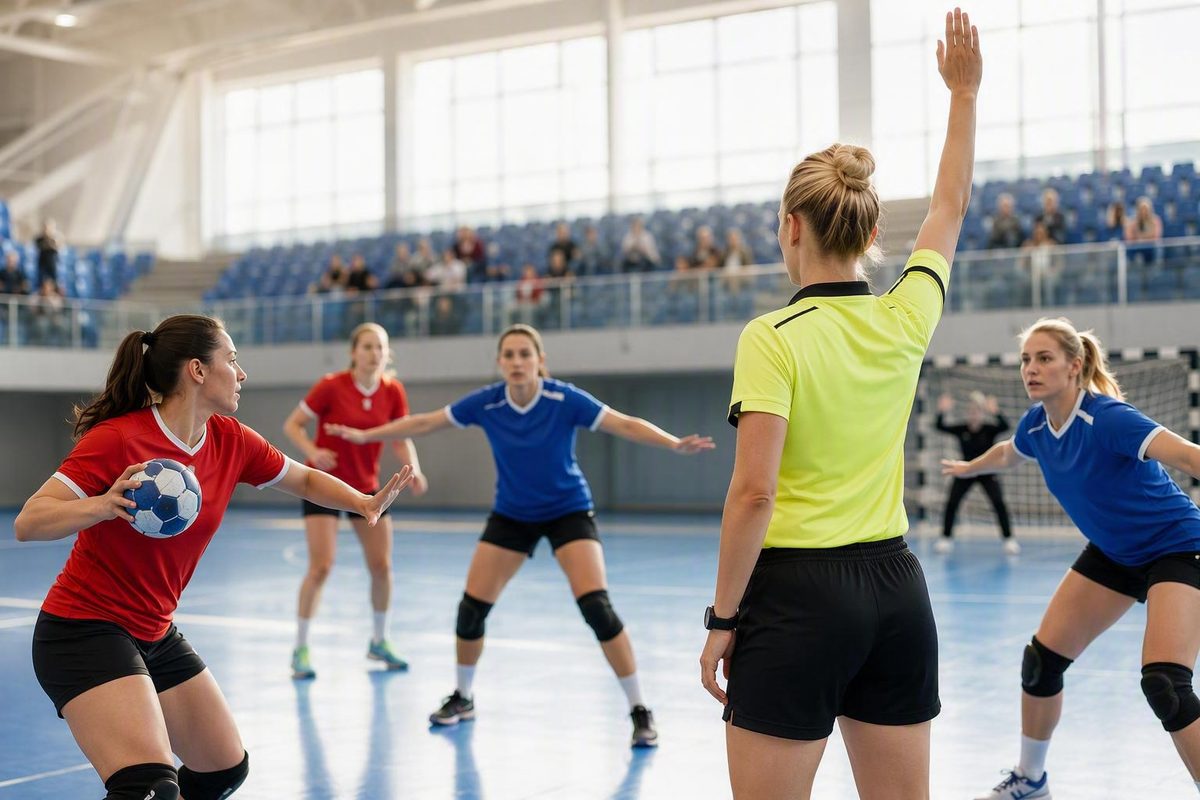
Referees judge attacking intent, then a raised arm begins a pass-limited phase; a true clock starts at a defined event and measures seconds.
Indoor handball does not start a continuously running possession clock when a team gains the ball. Referees first judge whether the attack remains purposeful. If they signal passive play by raising an arm, the attack enters a pass-limited phase governed by the relevant rules and exceptions. The current indoor framework is identified in Rules 7:11–12 and Clarification 4 of the IHF Rules of the Game effective in July 2025.
A conventional shot clock would use a different mechanism. It would begin at a defined event and count down a specified number of seconds, normally on a visible display. Passive play and a shot clock therefore address the same broad problem—indefinite possession—but measure an attack in fundamentally different ways.
Related: Why 30 Goals Is a Normal Handball Score.
The short answer: passive play is not a shot clock
Handball’s passive-play procedure has two broad stages:
- Before the warning: No dedicated possession countdown is running. Referees assess whether the attacking team is attempting to create a scoring opportunity or is merely retaining the ball.
- After the warning: The raised-arm signal moves the attack into a phase limited by a maximum number of passes, subject to the applicable rules and exceptions.
The warning is important because the measurable restriction does not begin automatically when possession changes. It begins only after the referees decide that the attack has become passive.
A conventional shot clock reverses that order. Its deadline begins with a rule-defined trigger, such as gaining possession, taking a restart or crossing halfway. It then measures seconds rather than passes. Players, coaches and spectators can usually see how much time remains.
The distinction is not merely technical. Under passive play, two possessions can last different lengths because officials may judge that one attack is still developing while another has stopped applying meaningful pressure. Even after the warning, four quick passes consume less time than four slower passes interrupted by defensive contact or a restart.
This article describes the verified structure of the indoor procedure and distinguishes it from reform proposals. It does not import beach-handball rules, which operate under a separate framework.
What can trigger a passive-play warning
Referees do not wait for a mandatory number of possession seconds. They assess attacking intent, movement and pace during the starting, build-up and finishing phases of an attack.
Possible indicators include:
- delaying a restart;
- waiting for substitutions instead of continuing the attack;
- moving the ball backward without defensive pressure;
- receiving the ball while stationary or moving away from goal;
- circulating the ball without putting pressure on the defense; and
- declining a good shooting opportunity.
These are indicators, not an automatic formula. An EHF-hosted referee education presentation describes passive-play enforcement as a matter of recognizing intentional delay and changes in attacking intent or speed.
Context affects that judgment. Referees may pay particular attention when an attacking team:
- holds a narrow lead late in the match;
- has fewer players because of a suspension; or
- is struggling against a superior defense.
None of those circumstances automatically makes an attack passive. At the same time, difficult conditions do not give a team unlimited permission to retain the ball without trying to create a chance.
When the referees decide that the attack is becoming passive, they raise an arm. The signal warns the attacking team and marks the transition into the pass-limited phase.
An independent rules explainer estimates that the warning commonly occurs after roughly 20–30 seconds, but it also states that there is no fixed time and that the decision depends on the behavior of both teams. The same explainer says the stated pass allowance is a maximum rather than an entitlement if the offense remains excessively passive or declines a clear path to goal. Both points are useful descriptions, not substitutes for the governing competition rules (Team Handball News’ passive-play FAQ).
What happens after the referee raises an arm
The raised arm changes the framework of the attack. Before the signal, referees make an open-ended judgment about whether the team is still attacking purposefully. After the signal, a maximum pass allowance provides a measurable outer limit, while referee judgment and the applicable exceptions remain relevant.
An official European Handball Federation explanation published on 20 May 2022 reported that the allowance would be reduced from six passes to four from 1 July 2022. It also reported that exceeding that allowance would result in a free throw for the defending team (the EHF’s explanation of the 2022 change).
That dated announcement establishes what the 2022 change introduced. The July 2025 IHF materials identify Rules 7:11–12 and Clarification 4 as the governing current provisions and indicate that exceptions form part of the procedure. The four-pass figure should therefore be understood as the rule reported as taking effect in 2022, not as proof that every exception or competition-specific variation operates identically in every setting.
Nor should the allowance be read as a guaranteed right to complete every listed pass. An independent explainer says officials may intervene sooner if the attacking side remains overtly passive, although that account is secondary guidance rather than the controlling rule text.
Even where the applicable allowance is four passes, the system is not a shot clock:
- it does not start automatically with possession;
- its trigger depends on referee judgment;
- it measures passes rather than elapsed time; and
- the real time available can vary with the speed of play, fouls and restarts.
The post-warning phase is measurable, but it is not a possession timer.
Passive play versus a shot clock: side-by-side
The current-rules column below is a high-level description based on the passive-play provisions identified in the July 2025 IHF indoor rulebook. The shot-clock column describes a hypothetical reform, not an existing indoor-handball rule.
| Feature | Indoor passive-play framework | Hypothetical shot clock |
|---|---|---|
| Trigger | Referees judge that the attack is becoming passive | A defined event starts the clock |
| Measurement | Passes after the warning | Seconds |
| Visibility | Raised arm, followed by an on-court pass sequence | Visible countdown |
| Warning | The raised arm begins the limited phase | Optional or set at a defined time |
| Sanction | The 2022 EHF explanation reported a defending-team free throw for exceeding the allowance | Turnover, free throw or another specified sanction |
| Resets | Controlled by the passive-play rules and exceptions | Stops and resets would be design choices |
| Discretion | Central to the initial warning and continued application | Reduced at the trigger but still needed for administration |
| Flexibility | Can account for whether an attack is genuinely developing | Applies a predictable deadline across different situations |
The principal advantage of passive play is contextual sensitivity. Officials can distinguish between deliberate delay and an attack that is taking longer because of aggressive defense, a substitution sequence or numerical disadvantage.
The principal advantage of a clock is visibility. If the start and reset rules were clear, everyone would know the deadline.
Neither structural advantage establishes that its system produces better scoring, fairness, pace, entertainment or officiating consistency. Those outcomes require comparative evidence rather than assumptions based on how the limit is displayed.
Worked possession: where fouls and free throws complicate the comparison
Consider a bounded example.
Team A gains possession and begins building an attack. No dedicated possession countdown starts. The defense shifts effectively, so Team A recycles the ball and attempts a second combination. The referees allow play to continue because the attack still appears purposeful.
Team A then slows down, circulates the ball without threatening the goal and declines opportunities to advance. The referees raise an arm, placing Team A in the applicable pass-limited phase.
Under the EHF’s dated 2022 explanation, the introduced limit was four passes and exceeding it resulted in a free throw for Team B (EHF’s 2022 rule-change explanation). The applicable competition rules and their exceptions still control the exact decision.
Now add the difficult edge case: close to the pass limit, a Team B defender commits a foul and Team A receives a free throw.
A third-party FAQ says that the initial pass following such a free throw counts toward the allowance. Because that source is not the official current rulebook and does not identify its governing edition, the detail should not be treated as a universal outcome for every current competition. The authoritative application comes from the operative Rule 7 provisions, Clarification 4 and any valid competition regulations.
A shot clock would not eliminate the issue. Its designers would have to decide whether a defensive foul would:
- leave the clock running;
- stop it and preserve the remaining time;
- produce a complete reset;
- add a specified amount of time; or
- trigger a reset only below a minimum threshold.
Each option creates different incentives. Stopping and restarting the clock may be more neutral, but it creates administrative questions about the precise stop and restart points.
Fans raise these implementation problems when discussing possible reforms. A community discussion proposing a fixed clock includes debate about warning timing, defensive fouls and free-throw situations. Those comments illustrate questions that a formal proposal would need to answer; they are not official rules, verified calculations or evidence of consensus.
The strongest case for each system
The strongest argument for a shot clock is clarity. A visible deadline would tell the attacking team exactly how much time remained, reduce the importance of when referees first decide to raise an arm and give newcomers an immediate explanation for why an attack must end.
A predefined trigger could also make possessions easier to compare. Instead of debating whether one team received more patience before the warning, spectators could follow the same displayed limit—provided that possession changes, fouls and resets were administered consistently.
Advocacy-style reporting has attributed support for a timed attack to coaches including Lino Červar, Antonio Carlos Ortega and Dragan Đukić. The same article attributed opposition to Germany’s national coach on the ground that a clock would change handball’s essence (Handball Planet’s shot-clock debate). These are reported opinions, not polling evidence, an official reform plan or proof of broad coaching support.
The strongest case for passive play is that attack quality cannot always be reduced to elapsed time. Referees can account for an attack disrupted by strong defense, substitutions or numerical inferiority while still acting against purposeless ball retention.
A clock would reduce one category of judgment—the timing of the initial passive-play warning—but it would not remove officiating discretion. Officials and table personnel would still need to determine:
- when possession changed;
- whether a foul occurred;
- when the ball was ready for a restart;
- whether a rebound created a new possession;
- whether an interruption justified stopping or resetting the clock; and
- how to correct an operator or display error.
The choice is therefore not objective timing versus subjective officiating. It is a trade-off between predictability and context.
What a real shot-clock proposal would need to define
“Introduce a shot clock” is not a complete rule. A workable proposal would have to specify:
- Clock duration: How many seconds would an attack receive?
- Start event: Would timing begin with possession, goalkeeper control, a restart or another event?
- Half-court progression: Would there be a separate deadline for advancing the ball?
- Stops and restarts: Which whistles would stop the clock, and when would it resume?
- Defensive fouls: Would the clock continue, pause, gain time or reset?
- Free throws: How much time would remain after the restart?
- Goalkeeper saves and rebounds: Which recoveries would create a new possession?
- Possession changes: How much control would be required before a new clock began?
- Time-outs and interruptions: How would official delays be administered?
- Sanctions: What would happen when time expired?
- Arena operation: Who would control the display, and how would errors be corrected?
The starting point alone could produce three substantially different systems. A possession-start clock would regulate the entire attack. A half-court-start clock would separate transition play from settled offense. A post-warning countdown would preserve referee judgment but measure the final phase in seconds instead of passes.
Foul and reset rules would be especially consequential. A defense should not gain an advantage simply by interrupting an attack, but an offense should not automatically receive a large tactical benefit from every infringement. Any serious proposal would need to balance those incentives explicitly.
None of the cited material provides controlled match data comparing passive play with a defined shot-clock model across possession length, scoring, turnovers, shot quality, fairness or officiating consistency. Claims that a clock would make handball faster, fairer or more entertaining therefore remain hypotheses.
For viewers, the practical cue is straightforward: a raised referee arm followed by a limited pass sequence signals passive play; a visible countdown beginning from a predefined event would be a true shot clock.